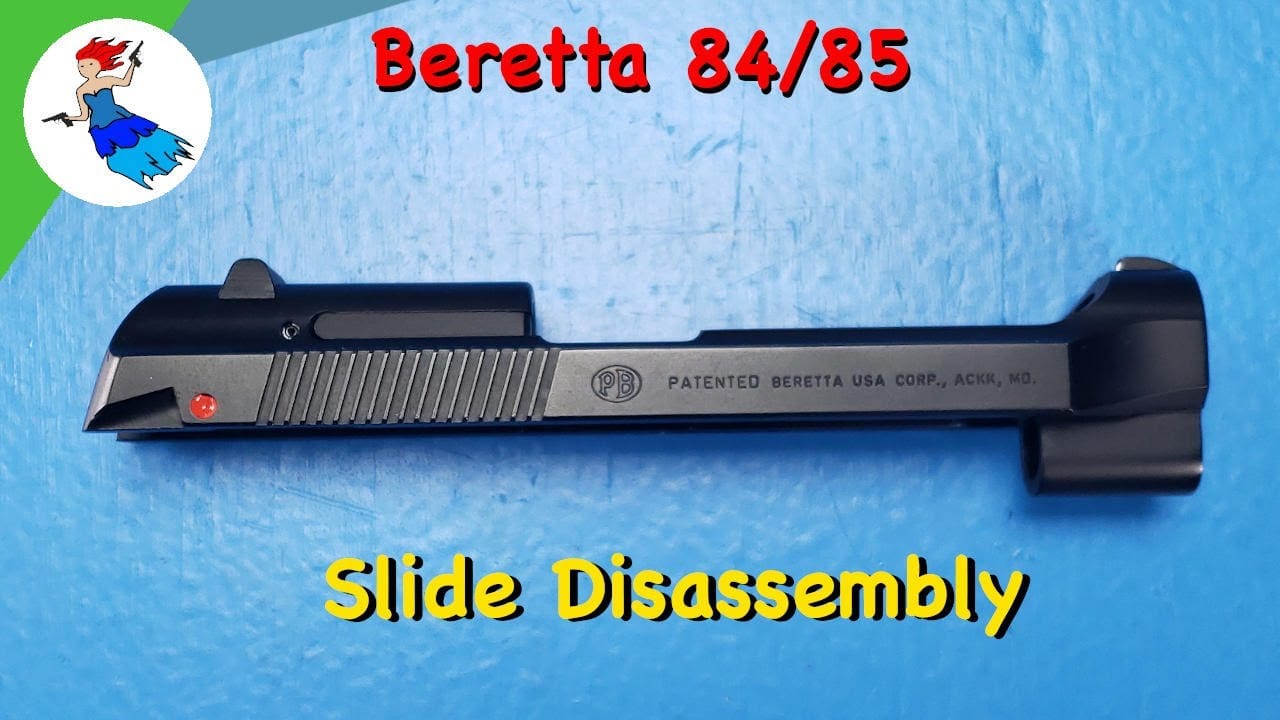
- Quick Answer: How do you disassemble a Beretta 80 Series slide?
- Models Covered
- Models Not Covered
- This guide also answers
- Tools & Parts Checklist
- Video Walkthrough
- Video Summary
- Step 1: Remove the Slide, Barrel, and Recoil Spring
- Step 2: Support the Slide Correctly
- Step 3: Remove the Extractor Pin
- Step 4: Remove the Extractor and Extractor Spring
- Step 5: Remove the Firing Pin Retaining Pins
- Step 6: Capture the Firing Pin Block and Spring
- Step 7: Remove the Firing Pin and Firing Pin Spring
- Inspector Checklist: What to Look For While It Is Apart
- Maintenance: Keep the Slide Running
- Quick Troubleshooting: Common Slide Disassembly Mistakes
- Extended FAQ
- Related Guides
- Final Thoughts: Confidence Through Competence
Are you having problems with failure to extract or failure to fire out of a Beretta 84 or 85? Your problem could be your slide. Let me show you how to break this slide down so you can replace worn parts or do a deep cleaning.
Although the Beretta 80 series slides look a lot like the Beretta 90 series slides, they are quite different. This guide walks you through slide disassembly for the Beretta 80 series: the Beretta 81, Beretta 82, Beretta 84, and Beretta 85 (F and FS models). The 82 is identical to the 84 except chambered in .32 ACP instead of .380 ACP, so the same steps apply. Note: This guide does not apply to the modern Beretta 80X (2023+). The 80X uses a different Browning-style locking block system, a barrel-mounted extractor, and its field strip procedure ends at slide removal and recoil spring removal. The factory manual explicitly states no further disassembly should be attempted outside a gunsmith shop.
The 80 series extractor rides in an internal channel, not on the outside like the 92 series. The firing pin is held by two coiled spring pins instead of a single retaining pin. If you have never taken one of these apart, the inner and outer retaining pins can be confusing. This guide shows the exact order and the exact punches to prevent mushroomed pins and scratched slides.
Quick Answer: How do you disassemble a Beretta 80 Series slide?
To disassemble a Beretta 80 Series slide, first remove the slide from the frame and remove the recoil spring and barrel. Support the slide on a bench block, drive out the extractor pin, remove the extractor and extractor spring, then drive the firing pin retaining pins out from left to right while controlling the firing pin block and spring. Capture the firing pin, firing pin spring, firing pin block, and catch spring as they come free.
Models Covered
- Beretta 81 Cheetah
- Beretta 82 Cheetah
- Beretta 84 Cheetah
- Beretta 84FS Cheetah
- Beretta 85 Cheetah
- Beretta 85FS Cheetah
Models Not Covered
- Beretta 80X Cheetah
This guide also answers
- How to disassemble a Beretta 84FS slide
- How to disassemble a Beretta 85FS slide
- How to remove the Beretta Cheetah extractor
- How to remove the Beretta 80 Series firing pin block
- How to remove the Beretta 80 Series firing pin
- Which direction the Beretta Cheetah retaining pins come out
Safety Gate: Read Before You Touch Anything
- Unload the pistol completely. Remove the magazine and visually inspect the chamber.
- Remove the slide from the frame before working on the slide parts.
- Wear safety glasses. The firing pin block spring and small pins can launch.
- Work over a clean towel or parts tray so small parts do not disappear.
- Do not force stuck pins. If a pin bends, mushrooms, or refuses to move, stop and reassess support and punch alignment.
Tools & Parts Checklist
| Tool / Part | Used For | Notes |
|---|---|---|
| Bench block | Supporting the slide | Prevents rail damage while pins are driven out. |
| 3/32-inch punch | Extractor pin and outer retaining pin removal | Use the correct size punch and keep it square to avoid mushrooming the pin. |
| 1/16-inch roll pin punch | Inner retaining pin removal | Small pins bend easily. Keep the punch square. |
| Small brass or plastic hammer | Controlled pin removal | Tap with control. Do not beat on the slide. |
| Safety glasses | Spring and pin protection | The firing pin block spring can launch. |
| White towel or parts tray | Small parts control | Makes pins and springs easier to see. |
Video Walkthrough
Video Summary
This video walks through Beretta 80 Series slide disassembly in real time. The walkthrough shows extractor pin removal, extractor and spring removal, firing pin retaining pin removal, firing pin block control, firing pin removal, and the inspection points to check before reassembly.
Watch the video if the written steps feel unclear. The hand position and punch angle matter more than brute force.
Step 1: Remove the Slide, Barrel, and Recoil Spring
Before you touch any slide parts, the slide must be off the frame. This is not optional. The extractor pin, retaining pins, and firing pin block are all inaccessible while the slide is assembled to the frame.
Confirm the pistol is unloaded. Remove the magazine. Rack the slide and lock it open if your model has a slide stop. Visually inspect the chamber and the magazine well. If the chamber is not empty, clear it before proceeding.
Field strip the pistol. For the Beretta 80 series, press the disassembly latch on the right side of the frame, rotate the takedown lever down, and slide the slide forward off the frame. Remove the recoil spring assembly and the barrel from the slide. Set the frame aside.
This guide covers slide work only. Frame and fire-control work is a separate procedure.
Step 2: Support the Slide Correctly
Place the slide on a gunsmith bench block so the rails are supported and the pin holes are clear. Do not leave the rails hanging over air. An unsupported slide will flex when you strike a punch, which bends pins and eggs the pin holes.
Position the slide so the pin you are working on is directly over a solid section of the bench block. Keep the punch square to the pin. A punch at an angle drives the pin sideways and mushrooms the head. If the pin starts to bend, stop. A bent pin is a damaged pin, and a damaged pin will gall the slide hole.
Pin Removal Direction: On the Beretta 80 series, always drive the firing pin retaining pins out from left to right. The right side of the slide is the installation side. Driving a pin back through the same hole it entered can egg the hole and ruin the slide. Place the slide on a padded surface before you strike anything.
Step 3: Remove the Extractor Pin
Start with the extractor pin. Unlike the 92 series where the extractor is external, the 80 series extractor is held in place by a single pin driven in from the bottom of the slide.
Drive the pin out from the bottom. Place the slide on the bench block with the bottom facing up. Use a 3/32-inch punch and drive the pin out from the bottom. Tap gently with a brass or plastic hammer. The pin should walk out smoothly after a few taps. If it hangs up, check that you are driving straight and not at an angle.
When the pin is flush with the surface, stop hammering. Switch to a thinner punch or probe to push it the rest of the way if needed. Do not keep hammering once the pin is out of the hole; you will damage the slide surface.
Pro Tip: If the pin is stuck with carbon or old oil, soak the area with Aegis Gun Care cleaner for ten minutes before you start tapping. Carbon acts like glue between the pin and the slide. A quick soak breaks the bond and prevents you from hammering harder than necessary.
Step 4: Remove the Extractor and Extractor Spring
With the extractor pin removed, the extractor is now held in place by your punch. Push down on the rear of the extractor and remove your punch. Now push the extractor forward and then lift it up and out of the slide.
The extractor claw hooks into the breech face. It will not fall out on its own until you push it forward to clear the hook. Be gentle; the extractor is a small spring steel part that can bend if you pry against the slide rails.
Rotate the slide and the extractor spring will fall out of its recess. If it does not fall out freely, tap the slide gently against your palm. The spring sits in a blind hole under the extractor. It is a small coil spring with one larger end. Lay it on your white towel immediately so it does not roll off the bench.
Pro Tip: Dirt and oil get trapped under the extractor and in the extractor channel. This is where failure-to-extract problems start. Make sure you clean the extractor and the extractor channel thoroughly to ensure the firearm continues to operate safely. A pipe cleaner soaked in solvent works well for the channel.
Step 5: Remove the Firing Pin Retaining Pins
Now move to the firing pin area. You will notice two retaining pins on the right-hand side of the slide: an inner pin and an outer pin. Start with the inner pin.
Inner retaining pin. Using a 1/16-inch roll pin punch, drive the inner pin out from left to right. A starter punch may not be long enough to completely remove the pin, so switch to a longer 1/16-inch punch if needed to finish the removal. As it walks out, place your free hand or a shop rag under the slide to catch it. These pins are small enough to vanish forever if they hit the floor.
Outer retaining pin. With the inner pin out, remove the outer firing pin retaining pin. Use a 3/32-inch roll pin punch to start the removal. A starter punch may not be long enough to clear the pin completely, so switch to a longer 3/32-inch punch if needed to finish the removal. As you remove your punch, you may hear the firing pin settle back onto the firing pin block. This is normal; the pin was under spring tension and is now relaxing into the channel.
Call a Pro: If either retaining pin is peened, mushroomed, or bent, do not try to drive it through. A damaged pin can gall the slide hole and ruin the retaining pin bore. The damaged end may need to be dressed flush before removal, but that is precision work near the slide. If you are not comfortable doing that without touching the slide, take it to a qualified gunsmith.
Step 6: Capture the Firing Pin Block and Spring
Even though the firing pin is sticking out the back of the slide, you still will not be able to remove it from the slide yet. Push down on the firing pin block with a punch, then slide your punch off and the firing pin block will pop out.
The block is spring-loaded. As you release pressure, the block will push upward and out of its hole. Keep your palm over the top of the slide so the block does not shoot across the room. The firing pin catch spring sits in a small recess at the bottom of the block. It is not directional; either end goes in first.
Inspect the catch spring for kinks or compression set. A catch spring that has lost tension will let the firing pin block sit too low and can prevent the block from moving freely during the firing cycle.
Warning: While removing the firing pin block, never look directly into the firing pin channel from the rear. The spring can launch the block out with force. Keep the slide oriented so the channel points away from your face, and keep your safety glasses on.
Step 7: Remove the Firing Pin and Firing Pin Spring
Pull the firing pin from the rear of the slide. The spring comes out with the firing pin. The spring is not directional; either end goes on first.
Inspect the firing pin tip for chipping, flattening, or bending. A damaged firing pin tip can cause light primer strikes or pierced primers. Inspect the firing pin shank for peening or galling where the retaining pins contact it. Peened metal can bind in the channel and cause intermittent failures to fire.
Pro Tip: Run a pipe cleaner soaked in solvent through the firing pin channel from the rear. Carbon buildup in this channel is a common cause of light primer strikes and sluggish firing pin movement in the 80 series. The channel is narrow, and a pipe cleaner works well. Finish with a dry pipe cleaner and a light protective film of CLP to help prevent corrosion.
Inspector Checklist: What to Look For While It Is Apart
Disassembly is the best time to find the small problems that cause big range-day failures. Inspect every part before cleaning and reassembly.
- Firing pin tip: Look for chips, flattening, bending, or off-center wear.
- Firing pin shank: Check for peening or burrs where the retaining pins contact the pin.
- Firing pin channel: Look for carbon, dried oil, brass flakes, or burrs.
- Firing pin block: Inspect the slot and edges for peening or damage.
- Extractor claw: The hook should be distinct and sharp, not rounded flat.
- Extractor spring: Replace it if it is rusty, kinked, weak, or shortened.
- Pin holes: Check for egging, burrs, or damage caused by prior punch work.
- Retaining pins: Replace pins that are bent, crushed, mushroomed, or loose.
Maintenance: Keep the Slide Running
As you can see, there are not many parts in these slides. That simplicity is what makes the Cheetah reliable. But simplicity still needs maintenance. A dirty firing pin channel, a weak extractor spring, or a clogged extractor recess will cause malfunctions that look like ammunition problems but are actually cleanliness problems. A quality cleaner and lube from Aegis Gun Care keeps the slide running smoothly between cleanings.
| Interval | What to Inspect | What to Replace | Notes |
|---|---|---|---|
| Every range session | Extractor claw, breech face debris | Nothing; clean only | A quick wipe prevents buildup |
| Every 1,000 rounds | Firing pin channel, extractor spring tension | Extractor spring if weak | Weak springs cause stovepipes and light strikes |
| Every 5,000 rounds | Firing pin tip, retaining pin tightness, extractor claw edge | Firing pin if chipped; extractor if claw is rounded | Parts wear gradually. Inspect before they fail |
Pro Tip: If your Cheetah starts having failure-to-extract or stovepipe malfunctions after running reliably for years, do not blame the ammo first. Pull the slide, check the extractor spring tension, and look at the extractor claw edge. A rounded claw or a tired spring will cause extraction problems that look like ammunition issues but are actually wear problems. The fix is a $5 spring and ten minutes on the bench.
Quick Troubleshooting: Common Slide Disassembly Mistakes
| Problem | Likely Cause | Fix |
|---|---|---|
| Extractor pin will not move | Carbon, old oil, poor slide support, or wrong punch angle | Add penetrating oil, support the slide correctly, and restart with the punch square. |
| Pin starts to mushroom | Wrong punch or excessive hammer force | Stop, replace the damaged pin, and use a correct roll pin punch. |
| Firing pin block launches | Spring pressure was not controlled | Work inside a clear tray and keep thumb pressure over the block during removal. |
| Firing pin will not come out | Retaining pin not fully removed or channel is dirty | Verify both retaining pins are clear, then clean the rear channel before forcing anything. |
| Extractor spring disappears | Spring tension released without containment | Work over a white towel or tray and remove the extractor slowly. |
Extended FAQ
Which direction do Beretta 80 Series slide pins come out?
For disassembly, drive the slide retaining pins out from left to right. Installation is the opposite direction. Supporting the slide correctly matters because driving pins against unsupported metal can egg the pin holes.
Can I disassemble a Beretta 84FS slide without a bench block?
You can improvise support with a padded wood block, but a proper bench block is safer. The slide needs support around the pin holes so the pins can move without bending or damaging the slide.
Why will the Beretta Cheetah extractor pin not move?
The extractor pin may be stuck from carbon, old oil, burrs, or previous damage. Add penetrating oil, support the slide correctly, and use the correct punch. Do not keep hammering if the pin starts to bend or mushroom.
Does this guide apply to the Beretta 80X Cheetah?
No. This guide applies to the older Beretta 80 Series Cheetah slides, including the 81, 82, 84, and 85 family. The modern Beretta 80X uses a different slide system and should not be treated as the same procedure.
Should I replace springs during Beretta 80 Series slide disassembly?
Replace springs if they are rusty, weak, kinked, shortened, or unknown in age. The extractor spring and firing pin spring are inexpensive parts that can cause annoying malfunctions when they go soft.
What parts should I inspect after disassembling a Beretta Cheetah slide?
Inspect the firing pin tip, firing pin shank, firing pin block, extractor claw, extractor spring, retaining pins, pin holes, and firing pin channel. Look for peening, burrs, cracks, rust, weak springs, and carbon buildup.
Related Guides
Once the slide is cleaned and inspected, follow the Beretta 80 Series Slide Assembly Guide to put the firing pin, retaining pins, extractor spring, and extractor back in the correct order.
For frame-level work, see the Beretta 80 Series Field Strip Guide. For cleaning and lubrication, see the Handgun Cleaning Guide.
Final Thoughts: Confidence Through Competence
The Beretta 80 series slide looks intimidating when you see the roll pins and the internal extractor for the first time, but the disassembly is straightforward once you know the sequence. There are a handful of parts, two roll pins, and one spring-loaded block. The whole job takes under ten minutes.
What separates a smooth disassembly from a frustrating afternoon is knowing the gotchas before you hit them. The pin removal direction. The extractor forward-lift motion. The spring-loaded firing pin block. These are the details that matter.
Clean your slide. Inspect your parts. Replace springs before they go soft. And when you do need to take it apart, follow the order: extractor pin, extractor, extractor spring, inner retaining pin, outer retaining pin, firing pin block, catch spring, firing pin and spring, then inspect everything.
The Cheetah has been running for decades because the design is simple, not because it is magic. Simple systems still need attention. Give them that attention, and they will keep running.
You do not need to be an armorer to keep your Beretta Cheetah running. You just need the right sequence and the patience to follow it.
