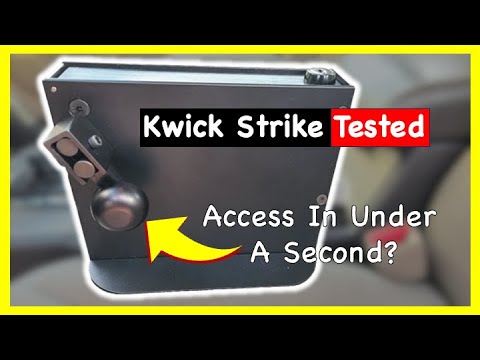
If you have ever tried drawing your carry gun while buckled into a vehicle, you already know the problem. Your seatbelt traps the gun, your jacket gets in the way, and suddenly the draw you have practiced hundreds of times becomes awkward. The Kwick Strike was designed to solve that exact problem.
The Kwick Strike is a mechanical, vehicle-mounted handgun storage device that slides between your seat and center console. It is not a safe. It is not a holster. It is a spring-loaded ejection system that puts your firearm in your hand when you press a knee-activated lever. No batteries, no electronics, no permanent modifications to your vehicle. It is made in the USA, patented, and built from 6061-T6 aluminum and oxide-plated steel. The idea is simple: faster access than digging under a seatbelt and jacket, with modest security to deter opportunistic theft.
Quick Answer: What’s the deal with KwickStrike?
- Knee Activated Fast Access Firearm Storage for Pistols
- Kwick Strike gives you sub-1-second access to a firearm in a vehicle
- Fitment, firearm options, and security limitations are real
What Is the Kwick Strike?
The Kwick Strike is a mechanical, vehicle-mounted handgun storage device that slides between your seat and center console. It’s not a safe. It’s not a holster. It’s a spring-loaded ejection system that puts your firearm in your hand when you press a knee-activated lever. No batteries, no electronics, no permanent modifications to your vehicle. It’s made in the USA, patented, and built from 6061-T6 aluminum and oxide-plated steel. The idea is simple: faster access than digging under a seatbelt and jacket, with modest security to deter opportunistic theft.
Testing the Kwick Strike
I tested the Kwick Strike in two vehicles: a 2010 Ford Fusion and a 1999 Dodge Durango. I’m 6’2″, which matters because the device’s usability depends on your height and your vehicle’s cabin space. I also tested it with five firearms: a SIG P365XL, a Glock 19 with a red dot and Streamlight TRL-1HL, a 1911 Commander, a SIG P220, and a 1911 Government with an extended beaver tail. The goal was to see what fits, what doesn’t, and whether the Kwick Strike lives up to its promise of under-one-second access.
In the Durango, the Kwick Strike worked flawlessly. It fit perfectly between the seat and console, didn’t interfere with any vehicle controls, and deployed every firearm I tested in under a second. The two that were too large didn’t fit. The knee-activated lever is intuitive, and the spring-loaded ejection is fast enough to feel like an extension of your own movement. If you drive a full-size truck or SUV and carry a compact or subcompact pistol, the Kwick Strike does what it says: faster access than an on-body holster without the bulk of a traditional vehicle safe.
In the Fusion, it was a different story. The cabin is tighter, and my height made it impossible to find a position where the device was both usable and accessible. If I set it low enough for my knee to activate the lever, it was too low to be practical. If I set it high enough to be useful, my knee couldn’t reliably trigger it. The bracket also interfered with the parking brake in every position I tried. A smaller driver might not have these issues, but for me, the Fusion was a no-go. The Kwick Strike’s fitment claims include 190+ vehicles, but my experience suggests that “fits” doesn’t always mean “works well for everyone.”
The Kwick Strike handled compact and subcompact pistols without issue. The Glock 19 with a red dot and weapon light fit, as did the SIG P365XL with a flashlight attachment. The 1911 Commander fit with about an inch of clearance. That inch matters more than it sounds. An extended magazine baseplate or oversized grip would have been the limiting factor, not the barrel length. It is a small detail, but one that saves you from discovering the problem after you buy the device. Full-size pistols, however, were a problem. The SIG P220 didn’t fit at all, and the 1911 Government with an extended beaver tail was too long. It fell off the rails during insertion. The manufacturer’s claim of “compact to midsize semi-autos” is accurate, but if you carry a full-size handgun, you’ll need to check compatibility carefully.
The red dot loading technique was one of the most surprising discoveries. If your pistol has a red dot mounted between the retention springs, the springs can catch on the optic during closure. The workaround? Cock the pistol slightly during insertion to create clearance, then close it the rest of the way. It’s not mentioned in the manual, but it’s a necessary step if you run a red dot. The Kwick Strike has a plastic piece at the top with foam padding underneath and a small slot designed for beaver tails. This slot also angles the pistol slightly, which helps prevent red dot interference with the springs. It’s a clever design, but it’s not foolproof. Government-size 1911s with extended beaver tails are still too long.
Speed and Operation
Speed is the Kwick Strike’s standout feature. Press your knee against the lever, and the firearm launches into your hand in under a second. There’s no fumbling with locks, no digging under seats, no wrestling with a cover garment. In a compatible vehicle, it’s faster than drawing from an on-body holster while seated. The mechanical design means there’s no risk of battery failure or electronic malfunction. It’s reliable, simple, and effective. Assuming it fits your vehicle and your firearm.
The plastic piece at the top of the device, with its foam padding and beaver tail slot, is a thoughtful detail. It’s designed to accommodate beaver tails, but it also helps angle pistols with red dots away from the retention springs. The foam padding protects the firearm from scratches, and the slot keeps the pistol stable during insertion. It’s a small feature, but it makes a difference in real-world usability.
The Kwick Strike’s installation is straightforward. Slide it between your seat and console, loop the security cable around a solid anchor point, and you’re done. There’s no permanent modification to your vehicle, and the device can be moved between vehicles if needed. The cable is long enough to secure around most seat frames or other sturdy points, but it’s not so long that it becomes cumbersome.
The manufacturer warns against dry-firing the mechanism. The spring-loaded ejection system has enough force to potentially cause damage if fired empty, so it’s important to follow the instructions: only activate the device when it’s installed in your vehicle with a firearm loaded.
Security and Tradeoffs
Security is where the Kwick Strike shows its limitations. The keyed cam lock is basic and can be picked with minimal effort. The steel braided rubber-coated cable is a deterrent, but it’s not hard to defeat. Any vehicle safe in this category uses a similar cable, so this isn’t unique to the Kwick Strike. When locked, the device provides moderate security. When unlocked, the top opens easily, which is great for access but not so great for theft prevention. The manufacturer’s positioning is clear: the Kwick Strike is built for accessibility, not robust security. If you’re looking for a way to deter smash-and-grab thieves, locking the device and pairing it with your vehicle’s alarm system is a reasonable approach. If you’re worried about a determined thief with tools, the Kwick Strike won’t stop them. As the tester put it: “If I want to steal your gun, I’m just going to cut the cable and take this thing with me.”
If you’re a taller driver in a smaller vehicle, the Kwick Strike might not work for you. My experience in the Fusion was frustrating, and I’m not the only one. Other tall drivers have reported similar issues in tight cabins. The device’s knee-activated design assumes a certain amount of space between the seat and console, and if your vehicle doesn’t provide that space, you’ll struggle to find a usable position.
The Kwick Strike’s biggest strength is its speed. In a compatible vehicle, it’s faster than digging under a seatbelt and jacket to access an on-body holster. It’s also more comfortable than keeping a firearm in your pocket or on your hip while driving. The mechanical design means there’s no risk of battery failure, and the lack of electronics means there’s nothing to malfunction. It’s a simple, effective solution for a specific problem: quick access to your firearm in a vehicle.
But it’s not a perfect solution. The security limitations are real, and the fitment issues in smaller vehicles are significant. If you’re looking for a way to secure your firearm in a vehicle, the Kwick Strike is a good option. But only if it fits your vehicle and your firearm. If you need robust security or carry a full-size handgun, you’ll need to look elsewhere.
Pricing and Warranty
Price varies by retailer. The manufacturer direct price is the most reliable starting point if you’re comparing options. The $229.99 price point is competitive for a mechanical vehicle storage device, especially one that doesn’t require permanent installation. The limited lifetime warranty is a nice touch, but it’s worth checking the terms to see what’s covered and what voids it.

Reviewed Product
Kwick Strike Vehicle Firearm Storage Device
$229.99 at Kwick Strike
Best for: Drivers of full-size trucks or SUVs who carry a compact pistol and want sub-second vehicle access without batteries or permanent installation
TRB take: A purpose-built mechanical solution for a specific problem. Fast, simple, and effective when it fits your vehicle and firearm. The tradeoff is real: speed over security.
View at Kwick StrikeDecision Rule
Buy the Kwick Strike if:
- You drive a full-size truck or SUV
- You carry a compact or subcompact pistol
- You want faster access than an on-body holster provides
- You prefer a mechanical system with no batteries or electronics
- You do not need robust security
Do not buy the Kwick Strike if:
- You drive a smaller vehicle or are a taller driver in a tight cabin
- You carry a full-size handgun
- You need robust security
- You want a permanent vehicle safe
How It Compares
| Feature | Kwick Strike | On-Body Holster | Vehicle Safe | Console Holster |
|---|---|---|---|---|
| Access Speed | Under one second | Slower when seated; must dig under seatbelt and jacket | Slow | Not specified |
| Security | Moderate; basic lock and cable deterrent | High; firearm stays on your person | Robust when properly installed | Not specified |
| Vehicle Fitment | 190+ claimed, but varies by cabin space and driver height | Universal | Bulky; often requires permanent installation | Not specified |
| Firearm Compatibility | Compact to midsize semi-autos | Universal | Varies by safe | Not specified |
| Installation | No permanent modification; slides between seat and console | None | Often permanent or semi-permanent | Not specified |
| Price | $229.99 | Varies | Varies; typically higher | Not specified |
FAQ
Q: How do you load a pistol with a red dot into the Kwick Strike?
Cock the pistol slightly during insertion to create clearance, then close it the rest of the way. It’s not mentioned in the manual, but it’s a necessary step if you run a red dot. The slot designed for beaver tails also angles the pistol slightly, which helps prevent red dot interference with the springs.
Q: What firearms fit in the Kwick Strike?
Compact and subcompact pistols fit without issue. The Glock 19 with a red dot and weapon light fit, as did the SIG P365XL with a flashlight attachment. The 1911 Commander fit with about an inch of clearance. Full-size pistols, however, were a problem. The SIG P220 didn’t fit at all, and the 1911 Government with an extended beaver tail was too long. The manufacturer’s claim of “compact to midsize semi-autos” is accurate.
Q: Will the Kwick Strike fit my vehicle?
The manufacturer claims fitment for 190+ vehicles, but “fits” doesn’t always mean “works well for everyone.” In a full-size truck or SUV like the 1999 Dodge Durango, it worked flawlessly. In a smaller sedan like the 2010 Ford Fusion, a taller driver may not find a usable position where the device is both accessible and knee-activated.
Q: Is the Kwick Strike secure?
The keyed cam lock is basic and can be picked with minimal effort. The steel braided rubber-coated cable is a deterrent, but it’s not hard to defeat. When locked, the device provides moderate security. When unlocked, the top opens easily. The manufacturer’s positioning is clear: the Kwick Strike is built for accessibility, not robust security.
Q: Can you dry-fire the Kwick Strike?
No. The manufacturer warns against dry-firing the mechanism. The spring-loaded ejection system has enough force to potentially cause damage if fired empty, so only activate the device when it’s installed in your vehicle with a firearm loaded.
Q: Is the Kwick Strike sold under another name?
No. Kwick Strike is a standalone product line and brand. It is not sold under any other name.
Q: What is the Kwick Strike made of?
It’s built from 6061-T6 aluminum and oxide-plated steel and made in the USA.
Verdict
If you drive a truck or SUV and carry a compact pistol every day, I would absolutely consider the Kwick Strike. It solved the accessibility problem in my Durango better than any vehicle-mounted option I have tested. On the other hand, if you drive a compact sedan or carry a full-size pistol, I would spend my money elsewhere because this simply is not the right tool for that job. The tradeoff is clear: speed and simplicity come at the cost of security and compatibility. Choose based on your actual needs, not the marketing claims.
Buyer Check
Before purchasing, verify:
- Vehicle fitment: Confirm your vehicle has enough space between the seat and console and appears on the manufacturer’s 190+ vehicle list
- Driver height: Taller drivers in smaller cabins may not find a usable knee-activation position
- Firearm size: Verify your handgun is compact to midsize; full-size handguns may not fit
- Red dot compatibility: Test the cock-during-insertion technique if your pistol has a red dot
- Security expectations: Understand that the lock and cable are deterrents, not robust security
- Warranty terms: Check what the limited lifetime warranty covers and what voids it
- Dry-fire warning: Follow the manufacturer’s instructions and never dry-fire the mechanism
“If I want to steal your gun, I’m just going to cut the cable and take this thing with me.”