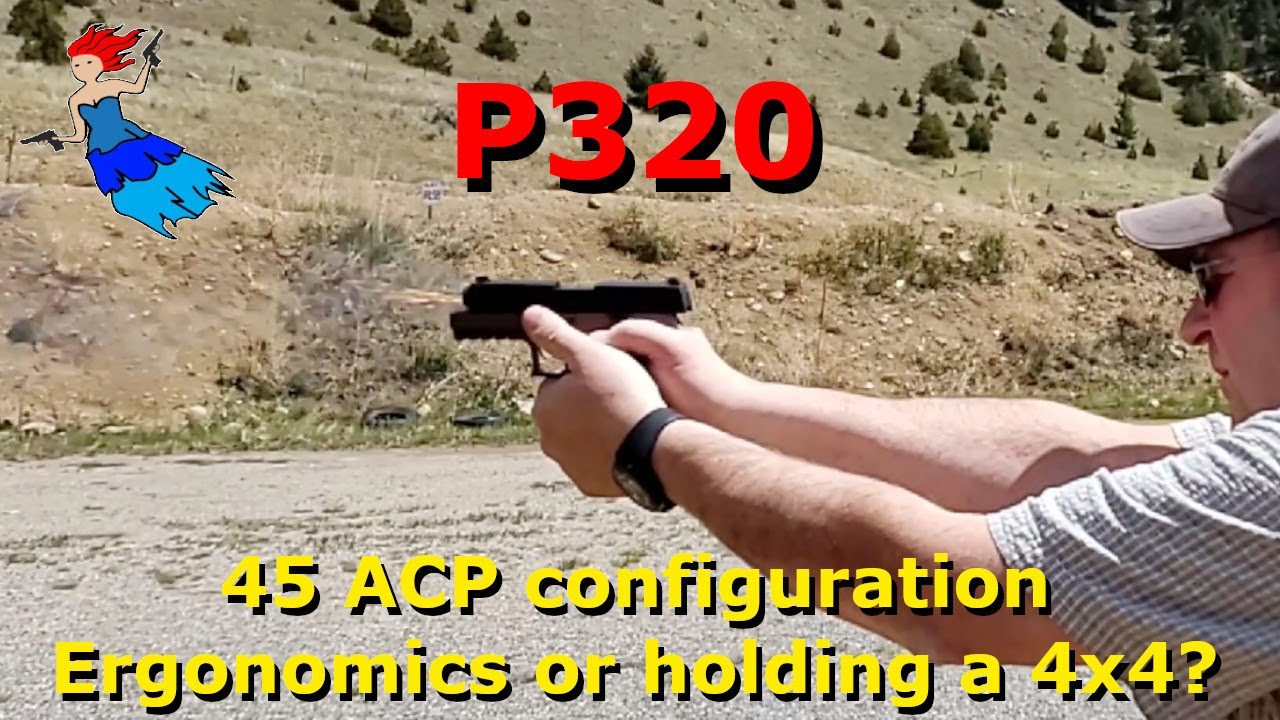
SIG P320 Compact in .45 ACP: The Modularity Myth
By Jason Schaller | July 3, 2020 | Updated 2026
When SIG Sauer launched the P320, they sold it on modularity. One serialized FCU, endless configurations. They never came out and said explicitly that every caliber would share the same FCU, but they never said otherwise either. Given the P250 had just done exactly that: one FCU, any caliber, just swap grip modules and slides. The implication was obvious. We all expected a striker-fired P250. What we got was different.
The 9mm and .40 shared FCUs, which reinforced the assumption. So when SIG announced the .45 ACP Compact, I assumed the same FCU would drop into a .45 grip module with a .45 slide. That is not what they built. That is not what we got.
Quick Pros & Cons
- Pros: Striker-fired trigger in .45 ACP, excellent grip ergonomics, solid construction, handles recoil well
- Cons: .45 FCU is NOT interchangeable with 9mm/.40, larger grip than smaller calibers, sparse aftermarket support, magazines expensive and hard to find, heavier than 9mm version
SIG Sauer P320 Compact .45 ACP
Note: Check availability at major retailers. .45 ACP models are often limited production.
TL;DR: The Truth About Modularity
- The P320 Compact in .45 ACP uses a physically different FCU than 9mm and .40 models. SIG never said it would be the same, but they never said it would be different, either.
- You cannot drop the .45 FCU into a 9mm grip module and run it, even with 9mm slide and barrel. The P250 allowed this. The P320 .45 does not.
- The .45’s ejector geometry and slide release are different. The FCU is physically larger. This is not a parts-swap situation. This is a different gun.
- 9-round magazine capacity versus 15 rounds in 9mm Compact. The capacity trade-off is real.
- The P250 delivered true modularity. The P320 9mm and .40 shared FCUs. The .45 broke the pattern without clear disclosure.
- Holsters interchange. Nothing else does. Not mags, not slides, not barrels, and certainly not the serialized FCU.
Who This Is For
Best for:
- Shooters who want .45 ACP specifically and don’t care about cross-caliber swapping
- Those who value the P320’s trigger and ergonomics over the P250’s true modularity
- Anyone tired of .45 platforms that feel like holding a 2×4
- Collectors or niche enthusiasts who understand this is a standalone gun, not a platform piece
Skip if:
- You expected SIG to honor the P250 modularity promise. They did not.
- You want actual interchangeability between P320 calibers, not marketing hype
- Higher magazine capacity is your priority (9mm offers 15+1)
- Budget is tight, mags and ammo cost more than 9mm
Table of Contents
First Impression
The first thing I noticed wasn’t the grip size, that obviously had to change for the bigger magazine. I expected the .45 grip module to be wider; you can’t fit a .45 cartridge in a 9mm-sized well. What stung was the FCU. Different ejector geometry. Different slide release dimensions. Different internal clearances. The serialized “gun” part that SIG marketed as the universal constant, the piece that legally is the firearm, turns out to be caliber-specific on the P320. The P250 didn’t do this. One FCU worked in .45, .40, or 9mm. SIG changed the rules for the P320 .45 and didn’t say so clearly.
Setting them side by side, the grip module difference is obvious and expected. The .45 magazine well is wider front-to-back, and a 9mm mag drops straight through, of course they don’t interchange. But the FCU? That should’ve dropped into a 9mm grip module with a 9mm slide and run. It doesn’t. The P250 would’ve accepted it. The P320 .45 won’t. That’s the letdown.
The slide is where the visual difference strikes you. Larger diameter barrel, thicker walls, more mass up front. That weight helps with muzzle flip, but it’s also a reminder that this gun was built around a cartridge the platform wasn’t originally designed for. The 9mm and .40 P320s share an architecture. The .45 diverged. First impression? SIG built a good .45, but they sold it under false pretenses if you expected the modularity the P320 name implies.
Real World Testing
I ran the .45 Compact alongside my 9mm P320 at the range, expecting to swap some parts and compare directly. That plan died immediately. The FCUs don’t interchange. So instead of one serialized heart swapping between calibers, I was looking at two completely separate handguns that happen to share a grip texture and marketing brochure.
Loading the first magazine, the .45 mags seat with a positive, heavy click. Beefier feed lips, stronger springs, thicker walls, SIG didn’t cut corners here. Racking the slide feels similar to the 9mm, though the recoil spring is stiffer to handle that bigger cartridge. The trigger is what you’d expect from a P320: flat face, clean break, reasonable reset. It’s the trigger that sold the platform, after all, the reason SIG moved away from the P250’s double-action.
The first magazine told me what I needed to know about recoil. Yes, it’s more than 9mm. No, it’s not punishing. The weight in that oversized slide and the grip geometry work together to keep the muzzle flatter than compact .45s have any right to be. Follow-up shots are slower than 9mm, physics doesn’t negotiate, but the gun doesn’t fight you. Where it gets complicated is the comparison: this isn’t a “configurable” .45. It’s just a .45. The modularity story ends at the grip module size. Everything upstream is locked to this caliber.
Accuracy was on par with other P320s at 10 and 15 yards. Same sight quality, same barrel manufacturing standards, same trigger characteristics. Groups opened up slightly on rapid-fire strings compared to my 9mm, but that was me managing recoil, not the gun failing. What stood out was the frustration: SIG built a good shooter, then hamstrung it with a locked ecosystem. A true modular .45 in this frame would have been remarkable. This is just… a decent .45.
What Changed After Real Use
After spending real time with this gun, my understanding of where it fits changed completely. Initially, I was annoyed by the modularity bait and switch. Not bait and switch in the legal sense, SIG never guaranteed cross-caliber FCU compatibility. But in the real sense, where the P250 had set expectations and the P320 9mm/.40 reinforced them, the .45 was a departure they did not clearly disclose.
What softened the frustration was recognizing what SIG actually built. The P250’s DAO hammer was its fatal flaw, reliable but that long, heavy pull cost it mainstream acceptance. The P320’s striker system fixed that. The trade-off appears to be that true universal modularity, the P250’s crown jewel, got sacrificed for the trigger everyone wanted. SIG chose striker-fired excellence over cross-caliber flexibility, then buried that choice in technical documentation instead of marketing clarity.
That grip texture, by the way, remains one of SIG’s best decisions. Consistent across all P320s, it means your grip and hand position translate even if the internals don’t. The .45 module fills your hand better than the 9mm, necessary to control that bigger cartridge, but the texture keeps it from feeling foreign. No relearning required on draw or presentation. Just the realization that you’re holding a different gun than your 9mm, not a different configuration.
The capacity trade-off became clearer too. Nine rounds of .45 versus fifteen of 9mm isn’t just a numbers game, it’s a philosophy choice. Bigger holes or more holes. The P320 .45 forces that decision, but unlike a truly modular system, it forces you to buy a whole second gun if you want to switch philosophies. The P250 would’ve let you reconfigure. This doesn’t.
What Held Up
Mechanically, the P320 Compact .45 is solid. Once I stopped expecting modularity and judged it as a standalone gun, the quality became apparent. The FCU, whatever its interchangeability limitations, functions reliably. Trigger break, reset, and take-up match my 9mm P320. If you own both, the manual of arms is identical even if the guts aren’t swappable. Training translates. That’s worth something.
The slide and barrel have handled everything I’ve thrown at them. SIG’s nitron finish holds up well, no premature wear despite regular carry rotation. Barrel lockup is consistent. Extraction has been reliable even with bargain remanufactured ammunition I’d hesitate to run in a competition gun. The .45 ACP runs at lower pressure than 9mm, which means less stress on components over time. If longevity matters, this gun has it.
What really holds up are the ergonomics. The grip module fills the hand properly. The texture provides purchase without being aggressive. The angle puts your finger on the trigger correctly. This matters more with .45 because you need that control. A slippery or undersized grip would make this cartridge unpleasant. SIG got the shape right, even if they got the modularity story wrong.
Magazine reliability has also been consistent. Early P320s had teething problems, but the .45 mags seem to have learned from those mistakes. Feed lips hold their shape, followers move smoothly, springs maintain tension. In approximately 1,600 rounds, I’ve had zero malfunctions attributable to the magazines. That’s not nothing. But it also doesn’t change the fact that these mags are proprietary to a dead-end platform piece that doesn’t share with the broader P320 ecosystem.
What Didn’t Hold Up
The modularity promise, obviously. I keep coming back to it because it’s central to what the P320 was sold as. The .45 version breaks that promise. You cannot take this FCU and drop it into a 9mm configuration. You cannot buy a .40 slide and barrel and convert this gun. The .45 stands alone. If that wasn’t what you signed up for, the disappointment is real.
Aftermarket support is predictably sparse. The 9mm P320 ecosystem is massive, magazine extensions, grip modules, triggers, holsters, slides, barrels. For the .45? Almost nothing. If you want a flared magwell, you’re modifying 9mm parts or fabricating your own. Competition trigger kits rarely list .45 compatibility. You’re on the fringes of an ecosystem that was supposed to welcome you.
Magazine availability stings more when you can’t borrow from the 9mm market. During panic buying cycles, elections, legislative threats, general unrest, the 9mm mags restock first. The .45 sits at the bottom of the priority list, which means higher prices and longer waits. If you carry this gun, you need a deep stash because resupply isn’t guaranteed.
The weight difference, while helping with recoil management, becomes apparent over long carry days. The .45 Compact is noticeably heavier than the 9mm version, not dramatically, but enough that you feel it by evening. Combined with the knowledge that you can’t just swap to a lighter configuration, it adds a layer of commitment that the marketing doesn’t prepare you for.
How It Compares
Comparing the P320 Compact .45 to its 9mm sibling isn’t really fair, they’re not siblings anymore, they’re distant cousins wearing the same brand. If capacity and fast follow-up shots matter, the 9mm wins because it’s an actual modular platform. Parts interchange. Slides swap. You can move between configurations.
Where the .45 makes its case is subjective: terminal ballistics and personal confidence. Some shooters trust .45 ACP more than 9mm based on experience, training, or preference. The P320 Compact .45 gives those shooters a modern striker-fired platform that doesn’t feel like a 1911 throwback. You get the cartridge you want in a gun that handles like contemporary design. You just don’t get the flexibility you were led to expect.
Compared to other compact .45s, Glock 30, Springfield XD Compact, S&W M&P45, the P320 distinguishes itself with ergonomics and trigger quality. Those other guns are what they are; you can’t reconfigure them. But here’s the irony: neither can the P320 .45. The modularity marketing falls apart when you realize this gun is as locked-in as any of its competitors. The FCU doesn’t move. The configurations don’t swap. It’s a .45 pistol, full stop.
The trigger remains the differentiator SIG intended. It’s not custom 1911-grade, but it’s better out of the box than most striker-fired alternatives. The flat face and clean break translate to accuracy. With .45’s larger bullet diameter, a better trigger means you can actually capitalize on the cartridge’s potential. That’s real. The modular promise just… isn’t.
Specs
| Caliber | .45 ACP |
| Overall Length | 7.2 inches |
| Barrel Length | 3.9 inches |
| Height | 5.3 inches |
| Width | 1.4 inches |
| Weight (unloaded) | 26.0 oz |
| Magazine Capacity | 9+1 rounds |
| Action | Striker-fired, internal hammer |
| Trigger Pull | ~5.5-7.5 lbs |
| FCU | Caliber-specific (not interchangeable with 9mm/.40) |
| Grip Module | Polymer, .45 ACP specific |
| Sights | SIGLITE Night Sights (standard), optic-ready slides available |
Honest Limitations
Before You Buy, The Reality Check
- No true modularity. The .45 FCU is caliber-specific. You cannot convert to 9mm or .40 by swapping parts. What you buy is what you have.
- The P250 won on modularity, lost on trigger. The P320 won on trigger, but the .45 sacrificed the P250’s cross-caliber FCU compatibility. That’s the trade-off.
- Capacity is limited. Nine rounds plus one. The 9mm offers 15+1. Choose your trade-off.
- Aftermarket is sparse. Most P320 accessories are 9mm-focused. You’ll compromise or fabricate.
- Magazines cost more and are harder to find. Stock deep during normal times; panic cycles leave you waiting.
- Weight matters for carry. Noticeably heavier than the 9mm. No modular shortcut to lighten it.
- Recoil is real. Manageable, but requires discipline. If recoil-sensitive, try before committing.
Recommended Add-ons
This pistol needs three things to be range ready: magazines, a holster, and ammo.
Magazines: Brownells – Factory P320 Compact .45 ACP 9-round magazines run about $45. Buy two. The compact mag is the right height for this grip; full-size mags work but stick out awkwardly.
Holster: Falco C105 – Leather IWB with steel clip, rides deep and stable. The C105 was built for the P320 Compact specifically, so retention and ride height are spot-on. ~$55.
Ammo: Target practice – PMC Bronze .45 ACP 230gr FMJ runs clean and groups tight in this barrel. Avoid steel-case during break-in; the P320’s tight tolerances show you every feeding hiccup.
Final Verdict
The Verdict
The SIG P320 Compact in .45 ACP is a good gun that breaks a big promise. If you want a .45 with a modern striker-fired trigger and excellent ergonomics, it delivers. If you bought into the P320 modularity story expecting to move between calibers with one FCU, the way the P250 allowed, you will be disappointed. The .45 is its own island. It doesn’t talk to the 9mm or .40 variants. The FCU is physically different, the ejector geometry is wrong for other calibers, and SIG’s marketing on this point is at best incomplete, at worst misleading.
So is it worth buying? If you want a standalone .45 and don’t care about modularity, yes. It’s reliable, comfortable, and shoots well. But if the modular promise mattered to you, if you expected P250 flexibility with a better trigger, this isn’t that gun. The P250 won on total modularity but lost on its double-action-only configuration. The P320 .45 won on trigger but sacrificed true modularity. Know what you’re getting into, and the gun won’t disappoint. Expect the marketing to be true, and it will.
FAQ
Can I use 9mm magazines in the .45 Compact?
No. The .45 magazines are significantly larger and will not fit in 9mm grip modules, and vice versa. You need caliber-specific magazines.
Will the .45 FCU work in a 9mm grip module?
No. This is the critical misconception. The .45 FCU is physically different from the 9mm and .40 versions. The ejector geometry, slide release dimensions, and internal clearances are all caliber-specific. You cannot swap an FCU between calibers. The P250 allowed this; the P320 .45 does not.
Is the .45 Compact harder to shoot than the 9mm?
Recoil is more pronounced with .45 ACP, but the P320’s grip design and slide weight help manage it. It’s not uncomfortable, but it requires more discipline than the 9mm version.
Are holsters interchangeable between calibers?
Yes. Holsters designed for the P320 Compact frame size will fit the .45 version since external dimensions are the same. This is literally the only thing that swaps.
Can I convert my 9mm P320 to .45?
No. Unlike the marketing implication, you cannot “convert” between calibers by swapping parts. The .45 requires its own FCU, slide, barrel, recoil spring, grip module, and magazines. You are buying a separate gun, not a configuration.
Is the .45 Compact reliable?
In my testing (~1,600 rounds), yes. Various ammunition types with no malfunctions attributable to the gun itself.
