A bad range bag becomes a black hole with shoulder straps. You dig for ear protection while the range officer waits. You cannot find that one magazine. Your cleaning kit is somewhere in the void. The right bag does not just carry gear. It keeps gear accessible when you need it and protected when you do not.
This guide is not about finding the biggest bag. It is about matching the bag to the way you actually shoot, carry gear, and work at the range.
For most shooters, the starting point is not a roller, a tactical backpack, or some duffel you stole from the gym closet. The starting point is a dedicated range bag built around pistols, magazines, ammunition, eye protection, ear protection, tools, and the small gear that makes a range trip work.
Quick Answer: What Range Bag Should You Start With?
- Start with a dedicated range bag if you want one bag for pistols, magazines, ammo, tools, eyes, ears, and range-day gear.
- Choose a dedicated pistol range bag if you mostly shoot handguns and want built-in magazine storage, pistol sleeves, and small-gear organization.
- Choose a rifle range bag or rifle case if the long gun is the main thing being protected and carried.
- Choose a duffel-style range bag if you park close and want fast bench access.
- Choose a backpack range bag if you walk farther, carry ammo cans, haul targets, or need both hands free.
- Choose a roller range bag only if your range is paved and you regularly carry heavy match gear.
- Skip MOLLE unless you already know what you plan to attach.
- Do not treat lockable zippers like a safe. They offer limited access control. They do not replace secure firearm storage or a hard-sided case when one is required.
Who This Guide Is For
- New shooters building their first real range setup
- DIY gun owners carrying tools, magazines, targets, and cleaning gear
- Handgun shooters who need a better way to organize pistols and magazines
- Shooters deciding between a dedicated range bag, backpack, duffel, roller, or rifle case
- Anyone tired of digging through one giant compartment every range trip
- Anyone trying to buy once instead of replacing a bad bag later
Who This Guide Is Not For
- People looking for a hard-sided airline firearm case
- People choosing a long-term firearm storage solution
- People building a full competition cart setup
- People looking for legal advice on firearm transport rules
Start With Your Reality
Before you look at bags, dump your current range gear on the floor. Not what you think you take. What you actually take.
Your normal range loadout might include:
- Eye and ear protection
- Ammunition in factory boxes, ammo boxes, or loaded magazines
- Firearm case, pistol sleeve, or padded firearm compartment
- Magazines
- Targets, stapler, or target tape
- Multi-tool or compact tool kit
- Cleaning cloth, lubricant, or compact cleaning kit
- Spare batteries
- Chamber flags
- Notebook and pen
- Small first-aid kit
That pile is your reality check. A bag that cannot fit it comfortably is the wrong bag, no matter how good the product photos look.
Reality Check: Do not size the bag for the one trip a year when you bring everything. Size it for the range trip you actually make most often.
Pistol Range Bag vs Rifle Range Bag
This is the first split most shooters should make.
A pistol range bag is built around smaller gear. Think handguns, magazines, ammunition boxes, tools, safety gear, and admin pockets. A good pistol range bag keeps the small stuff separated so you are not digging through loose magazines, batteries, earplugs, and ammo boxes.
A rifle range bag or rifle case is built around protecting the long gun first. The main compartment is usually for the rifle, optic, sling, and attached accessories. Extra gear storage matters, but it is secondary to protecting the firearm itself.
| Bag Type | Best For | What It Solves | Watch Out For |
|---|---|---|---|
| Dedicated pistol range bag | Handgun range trips, magazines, ammo, tools | Organizes small gear around pistol use | Pistol sleeve length, optic clearance, loaded weight |
| Rifle range bag or rifle case | Long guns, optics, slings, rifle accessories | Protects the firearm first | Interior length, optic height, muzzle device length |
| General range duffel | Flexible range gear storage | Carries mixed gear with fast bench access | Can become one big loose compartment |
Buyer check: A pistol range bag and a rifle bag are not interchangeable. A pistol bag organizes smaller gear around handguns and magazines. A rifle bag protects the long gun first and usually treats the extra gear as secondary.
The Main Range Bag Formats
Once you know whether you need a pistol-focused bag, rifle-focused bag, or general range bag, the next question is format.
| Format | Best For | Worst For | What to Check |
|---|---|---|---|
| Dedicated pistol range bag | Handguns, magazines, ammo, small tools | Long guns or bulky range gear | Pistol sleeves, mag pockets, interior structure |
| Duffel-style range bag | Short walks, trunk storage, bench access | Long walks, uneven ground, hands-full trips | Wide opening, flat base, padded shoulder strap |
| Backpack range bag | Hands-free carry, longer walks, heavier loads | Fast bench access | Padded straps, clamshell opening, weight distribution |
| Roller range bag | Paved ranges, match gear, heavy loads | Gravel, dirt, stairs, mud | Sturdy wheels, rigid frame, telescoping handle |
| Rifle range bag or rifle case | Long guns and optics | Small gear organization as the main goal | Interior length, padding, optic clearance |
Decision rule: If you mostly shoot handguns, start with a dedicated pistol range bag. If you mostly shoot rifles, start with a rifle bag or rifle case. If your problem is carrying tools, ammo, and mixed gear, then choose between duffel, backpack, or roller based on how far you walk and how much you carry.
Dedicated Range Bags: The Default Starting Point
A dedicated range bag is the normal answer for most pistol shooters because it is designed around the actual mess of a range trip.
A good dedicated range bag gives you places for:
- Pistols or padded pistol sleeves
- Magazines
- Ammunition boxes
- Eye and ear protection
- Small tools
- Cleaning supplies
- Targets and tape
- Batteries, chamber flags, and small parts
This matters because range trips are not just about carrying a firearm. They are about carrying all the support gear without losing your mind.
What to check: Look at the internal layout before you look at the outside. A dedicated range bag should have enough structure to keep gear separated. If it is just one big soft compartment with a logo on the side, it may not solve the problem.
Fit check: If you use optics, lights, compensators, or extended magazines, confirm the pistol sleeves and pockets actually fit your setup. A bag that fits a plain pistol may not fit the pistol you actually take to the range.
Best Range Bag Type by Use Case
| If You… | Start With… | Why | Watch Out For |
|---|---|---|---|
| Mostly shoot pistols | Dedicated pistol range bag | Built around handguns, mags, ammo, and small gear | Sleeve size, mag pocket fit, loaded weight |
| Mostly shoot rifles | Rifle bag or rifle case | Protects the firearm first | Optic clearance, interior length, padding |
| Park close and want bench access | Duffel-style range bag | Easy to open and work from | One-shoulder carry gets old when overloaded |
| Walk far or carry extra gear | Backpack range bag | Keeps both hands free | Top-loading designs can bury your gear |
| Shoot matches on paved ranges | Roller range bag | Handles heavier loads better | Bad wheels turn into a punishment system |
| Want low-profile transport | Discreet range bag | Does not advertise what is inside | May lack firearm-specific organization |
| Already own a sturdy tool bag | Tool-bag alternative | Cheap way to test your loadout | No pistol sleeves or magazine retention |
Material: Denier Isn’t Everything
600D, 1000D, 1680D. Higher numbers usually mean thicker fabric. But fabric is only part of the story.
| Material | Best For | What to Watch For |
|---|---|---|
| 600D polyester or nylon | Occasional use, indoor storage, lighter loads | May wear faster if dragged on rough surfaces |
| 1000D Cordura or similar heavy nylon | Frequent use, heavier loads, rougher handling | Heavier than lighter fabrics |
| 1680D ballistic nylon or heavy-duty fabric | Daily use, vehicle storage, travel, hard use | May be unnecessary weight for casual range trips |
Decision rule: If you shoot occasionally and store your bag indoors, lighter fabric may be fine. If the bag sees frequent use, truck beds, gravel, and heavier loads, heavier fabric starts making more sense. Just remember that poor stitching can fail before the fabric does.
Feature Priority Table
| Feature | Why It Matters | Priority | Skip If |
|---|---|---|---|
| Structured interior | Keeps pistols, mags, ammo, and tools separated | High | Almost never skip for pistol range bags |
| Reinforced bottom | Protects against damp ground, gravel, and bench abuse | High | Almost never skip |
| Heavy zippers | Zippers are a common failure point | High | Do not skip for heavy loads |
| Pistol sleeves or padded compartments | Keeps firearms and optics separated from tools and ammo | High for pistol bags | Skip if firearms travel in separate cases |
| Magazine pockets | Keeps magazines organized and easier to count | Medium to high | Skip if you use separate mag carriers |
| Adjustable dividers | Let the bag adapt to different trips | Medium to high | Skip only if your loadout never changes |
| MOLLE webbing | Adds external pouch options | Low | Skip unless you already use pouches |
| Lockable zipper pulls | Adds limited access control | Situation dependent | Never treat as secure storage |
Organization: Empty Space Is the Enemy
A big empty compartment becomes a jumble. You need structure.
What Works
- Pistol sleeves: These keep handguns separated from tools, magazines, and ammunition boxes. Check sleeve length if you run optics, lights, comps, or full-size pistols.
- Magazine pockets: Dedicated mag storage keeps magazines upright, easier to count, and less likely to beat up other gear.
- Removable dividers: Hook-and-loop or snap-in dividers let you configure the interior to match your loadout. Check that dividers stay put when the bag moves.
- Fixed compartments: Padded sleeves, magazine slots, and admin pockets work well when your loadout is consistent.
- Mesh pockets: Mesh makes small items easier to see, but it can tear faster than solid fabric.
- Exterior pockets: These should hold items you need fast, like ear protection, eye protection, targets, tape, or a stapler.
Skepticism callout: MOLLE is how a simple range bag begins applying for tactical office space. Do not pay for webbing you will not use.
Zippers: The Most Common Failure Point
Zippers fail at the worst times, usually when the bag is loaded and you are trying to close it without making a yard sale on the bench.
What to Look For
- Brand and build quality: YKK branding is a positive sign. It is not the only good zipper brand, but it suggests the manufacturer did not go bargain-bin on the closure.
- Zipper gauge: Larger zippers usually handle stress better. #8 or #10 zippers make sense on main compartments. Smaller zippers are usually fine on light-duty pockets.
- Smooth operation: A zipper that binds when the bag is empty will not improve once the bag is full.
- Lockable zipper pulls: Two zipper pulls that meet can accept a small lock. This is not secure storage. It is a modest barrier to casual access.
Travel note: Firearm travel rules vary by location, airline, and situation. A soft range bag usually does not replace a locked hard-sided firearm case where one is required. Check current rules before traveling with firearms, magazines, or ammunition.
Range Bag Picks by Use Case
The picks below are organized by use case because a new pistol shooter, a rifle shooter, a match shooter, and a guy hauling half his bench to the range do not need the same bag.
Best Dedicated Pistol Range Bag

Workbench Pick
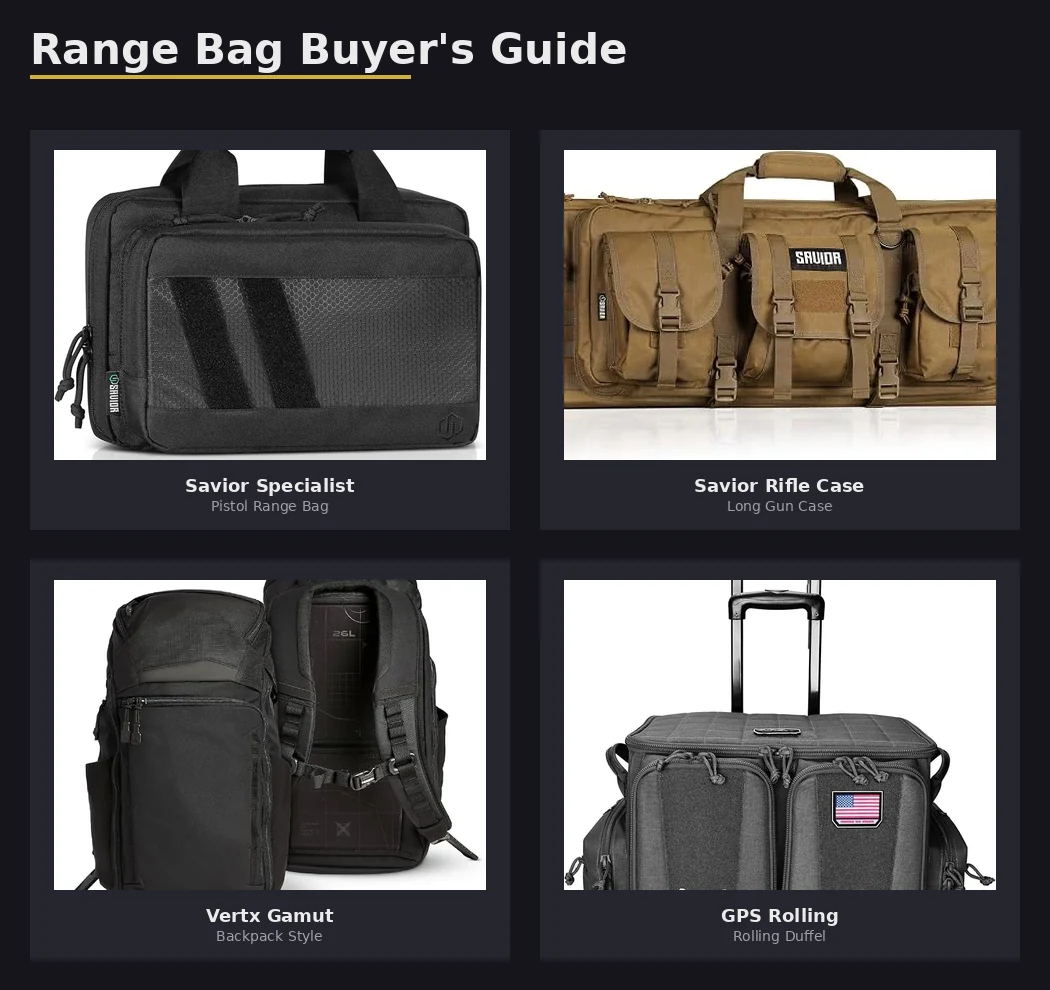
Savior Equipment Specialist Series Pistol Range Bag
$89-$129 at Savior Equipment
Best for: Dedicated pistol storage with padded sleeves and magazine organization
TRB take: Purpose-built for pistol shooters. Rigid structure keeps everything accessible at the bench.
Check PriceBest for: Shooters who want one bag for pistols, magazines, ammunition, eye protection, ear protection, tools, and range-day support gear.
Why this category matters: A dedicated pistol range bag already solves the organization problem. You get pistol sleeves, magazine storage, small-gear pockets, and a structured interior without trying to turn a gym bag into a range bag.
Watch out for: Pistol sleeve length, optic clearance, loaded weight, zipper quality, and whether the bag still opens cleanly when packed.
Skip if: You mostly shoot rifles, need a rifle-length case, or already carry pistols in separate cases inside another bag.
Best Rifle Range Bag or Rifle Case
Workbench Pick
Savior Equipment American Classic Rifle Case
$129-$179 at Savior Equipment
Best for: Scoped rifle transport with padded protection and optic clearance
TRB take: Thick foam and robust zippers. The go-to for rifle shooters who don't want to guess about protection.
Check PriceBest for: Shooters whose main concern is carrying and protecting a rifle, carbine, or long gun with optics and accessories.
Why this category matters: A rifle bag protects the firearm first. Extra pockets matter, but they are secondary to interior length, padding, optic clearance, and how the rifle rides inside the case.
Watch out for: Interior length, muzzle device clearance, optic height, sling storage, magazine pockets, and whether the case gets too bulky once loaded.
Skip if: You are only looking for a pistol and gear organizer.
Best Duffel-Style Range Bag
Workbench Pick
5.11 Tactical Range Ready Bag
$77.99 at Brownells.com
Best for: Wide-opening duffel with flat base and integrated brass/ammo organization
TRB take: The duffel that actually knows what shooters need. Flat base, YKK zippers, and pockets that make sense.
Check Price at BrownellsBest for: Short walks, bench access, and shooters who want flexible open storage.
Why this category matters: A duffel opens wide and makes it easier to work from the bag once you are at the bench.
Watch out for: Weak zippers, thin bottoms, poor shoulder straps, and one large compartment with no dividers.
Skip if: You walk a long distance, carry heavy ammunition, or need both hands free.
Best Backpack Range Bag
Workbench Pick
Vertx Gamut 2.0
$179-$219 at Vertx
Best for: Hands-free range transport with clamshell opening and load distribution
TRB take: Clamshell opening means you see everything at once. Padded straps mean you don't regret the walk to bay 12.
Check PriceBest for: Shooters with long walks, ammo cans, target stands, or hands-full range trips.
Why this category matters: Backpack straps distribute weight better and keep both hands free.
Watch out for: Top-loading layouts that bury tools, magazines, and small parts under ammunition boxes.
Skip if: You mostly shoot from a bench and want the fastest access to your gear.
Best Roller Range Bag
Workbench Pick
GPS Outdoors Rolling Range Bag
$149-$189 at GPS Outdoors
Best for: Heavy-load rolling transport with inline wheels and telescoping handle
TRB take: Wheels that don't quit and a frame that doesn't sag. For shooters who bring everything.
Check PriceBest for: Competition shooters or heavy-load range trips on paved surfaces.
Why this category matters: Wheels help when the load gets heavy and the terrain cooperates.
Watch out for: Gravel, dirt, stairs, mud, and cheap wheel assemblies.
Skip if: Your range has rough ground or you regularly carry gear over uneven surfaces.
Best Discreet Range Bag
Workbench Pick
5.11 LV6 Pack
$269.95 at Brownells.com
Best for: Low-profile carry with no tactical styling but firearm-specific interior organization
TRB take: Looks like any other daypack. Works like a range bag. The LV6 is for shooters who value discretion.
Check Price at BrownellsBest for: Shooters who want low-profile transport without loud branding or tactical styling.
Why this category matters: A plain-looking bag attracts less attention in parking lots, hotels, and vehicles.
Watch out for: Generic bags that lack padding, magazine retention, or reinforced bottoms.
Skip if: You need firearm-specific organization more than low-profile appearance.
Best Tool-Bag Alternative
Best for: Budget-minded shooters who already own a sturdy tool bag or want to test their loadout before buying a dedicated range bag.
Why this category matters: Tool bags often have strong bottoms, open compartments, and good weight capacity.
Watch out for: Lack of firearm padding, no magazine sleeves, and too many loose tools near finished surfaces.
Skip if: You want dedicated firearm compartments and range-specific organization from day one.
Useful Range Bag Add-Ons
Only add gear that solves a problem you actually have. A clean range bag beats a stuffed range bag.
| Add-On | What It Solves | Skip If |
|---|---|---|
| Small tool roll | Keeps punches, hex keys, and drivers from floating loose | Your bag already has reinforced tool pockets |
| Ammo boxes | Keeps loose ammunition organized and protected | You only carry sealed factory boxes |
| Chamber flags | Useful for classes, matches, and range safety checks | Your range does not require them and you do not use them |
| Small first-aid kit | Handles small range-day problems without digging through your vehicle | You already carry one separately |
| Water-resistant pouch | Protects batteries, paperwork, small electronics, and notes | Your bag already has sealed pockets |
Common Mistakes and How to Avoid Them
Mistake: Buying a Generic Bag When You Need a Dedicated Range Bag
What happens: The bag carries your gear, but it does not organize it. Pistols, magazines, tools, and ammo all fight for the same space.
How to avoid it: If your main loadout is handguns, magazines, ammunition, and small tools, start by looking at dedicated pistol range bags before general duffels.
Mistake: Buying for Capacity Without Organization
What happens: A big empty space becomes a mess. You spend more time digging than shooting.
How to avoid it: Look for dividers, dedicated pockets, pistol sleeves, magazine storage, and a layout that matches how you actually pack.
Mistake: Ignoring Empty Bag Weight
What happens: A heavy bag before you add gear becomes a miserable bag when loaded. A 5-pound empty bag plus 15 pounds of gear means you are carrying 20 pounds before the day really starts.
How to avoid it: Check the empty weight. A lighter bag is easier to carry, especially if your range involves a long walk.
Mistake: Choosing Style Over Carry Comfort
What happens: You buy the bag that looks good online, then leave half your gear in the vehicle because the straps punish you.
How to avoid it: Test the carry method. Shoulder straps should be padded. Backpack straps should distribute weight. Handles should feel secure when the bag is loaded.
Mistake: Trusting Lockable Zippers as Security
What happens: You treat a soft bag like secure storage when it is only a transport and organization tool.
How to avoid it: Do not leave your bag visible in an unattended vehicle. Lock it in the trunk or covered cargo area when possible. Use proper secure storage when secure storage is required.
Mistake: Buying Without Checking Interior Dimensions
What happens: Your gear almost fits, which means it does not fit.
How to avoid it: Lay out your gear and measure it. Compare that pile to the bag’s interior dimensions, not just the exterior size listed online.
Range Bag Buying Checklist
Before you buy, ask yourself:
- Am I buying for pistols, rifles, or mixed gear?
- Does it fit my actual loadout?
- Will my pistol fit with its optic, light, compensator, or extended magazine?
- Can I carry the bag comfortably when loaded?
- Does the carry method match my range parking situation?
- Does it open wide enough to find gear quickly?
- Are the zippers smooth, strong, and properly stitched?
- Are the handles and strap anchors reinforced?
- Does the bottom resist damp ground and abrasion?
- Does the organization match how I pack?
- Am I paying for MOLLE I will not use?
- Does the price reflect construction quality, not just branding?
FAQ
What is the best range bag for a new shooter?
For most new handgun shooters, a dedicated pistol range bag is the best starting point. Look for a reinforced bottom, decent zippers, pistol sleeves, magazine storage, and enough room for eye protection, ear protection, ammunition, and basic tools. You do not need a professional-grade bag yet. Learn what you actually carry first.
Should I buy a dedicated range bag or use a regular duffel?
Use a dedicated range bag if you want built-in organization for pistols, magazines, ammunition, tools, and small gear. Use a regular duffel only if you already have separate pouches, pistol cases, and organizers. A duffel carries gear. A good range bag organizes it.
What is the difference between a pistol range bag and a rifle range bag?
A pistol range bag organizes handguns, magazines, ammo, tools, and safety gear. A rifle range bag or rifle case protects the long gun first, with extra storage for magazines and accessories. Start with what firearm you are actually carrying.
Are expensive range bags worth it?
Sometimes. A better-built bag can save replacement costs and frustration, but price does not always equal quality. Check stitching, zippers, strap anchors, bottom reinforcement, interior structure, and layout. An expensive bag with bad organization is still the wrong bag.
Can I use a regular gym bag or backpack?
You can, but range gear has specific needs. Firearms need padding and separation. Magazines need retention. Ammunition is heavy. A gym bag works in a pinch, but a purpose-built range bag usually works better once you know what you carry.
Can I use a tool bag as a range bag?
Yes, and it can be a smart budget option. Tool bags often have strong bottoms and open compartments. The tradeoff is that they usually lack padded firearm sleeves, magazine retention, and range-specific organization.
Should I get a duffel or backpack range bag?
Choose a duffel if bench access matters more than carry distance. Choose a backpack if you walk farther, carry extra gear, or need both hands free. Neither one wins by default. Your range setup decides.
Are roller range bags worth it?
Roller range bags make sense when you carry heavy gear over paved surfaces. They are less useful on gravel, dirt, stairs, mud, or rough outdoor ranges. Wheels only help when the ground lets them.
Do I need MOLLE webbing?
Only if you will use it. MOLLE lets you attach pouches and accessories, but it adds weight, cost, and exterior bulk. If you do not already know what you plan to attach, skip it.
What is denier?
Denier measures fiber thickness in fabric. Higher numbers usually mean thicker material, but that does not automatically mean the bag is better. Stitching, zippers, coating, and reinforcement matter just as much.
Are waterproof range bags necessary?
Water-resistant is usually enough for casual range use. A bag that sheds light rain and has a protected bottom handles most normal conditions. True waterproofing can add cost and weight that many shooters do not need.
How long should a good range bag last?
That depends on load weight, use frequency, storage conditions, and how often the bag gets dragged across rough surfaces. Inspect the handles, zipper tracks, bottom seams, and shoulder-strap anchors regularly. Those areas usually fail before the main fabric wears out.
How do I clean a range bag?
Empty it completely. Shake out loose debris. Brush off dirt. Spot clean stains with mild soap and water. Let the bag dry fully before storage. Do not machine wash unless the manufacturer specifically allows it.
Can a soft range bag replace a hard case for travel?
No. A soft range bag is for organization and transport, not secure firearm storage. Travel rules vary, and air travel has separate requirements. Check current rules before traveling with firearms, magazines, or ammunition.
Final Thoughts
Start with the obvious question: are you carrying pistols, rifles, or just a pile of loose range gear pretending to be organized?
If you mostly shoot handguns, a dedicated pistol range bag is usually the cleanest starting point. If you mostly shoot rifles, protect the rifle first and let the gear pockets come second. If you are hauling mixed gear, then decide whether bench access, hands-free carry, or heavy-load transport matters most.
The right bag fits your loadout, carries comfortably, opens cleanly, and lets you find your gear without digging through nylon soup. Everything else is marketing.
Before ordering another bag, dump your current one on the floor. If you find loose rounds, three dead batteries, and an Allen key from a gun you sold two years ago, congratulations. You just completed the first step of range bag selection.